
Freshman Ada Hanners has been captivated by storms ever since she was little. She doesn’t remember a specific time her interest started, but rather that storms have always caught her attention.
“I would always look at the clouds and had to write multiple research papers on them for classes,” Hanners said. “Whenever there’s a weather alert in the area I always want to just go and find it and see it for myself. Outside of school, I would watch the weather, and my friends would rely on me to keep them updated. I took into mind how proud I felt when I had correctly identified the outcome of a storm for the first time, and that really set off the bell for me. I now watch the weather and check the forecast every day.”
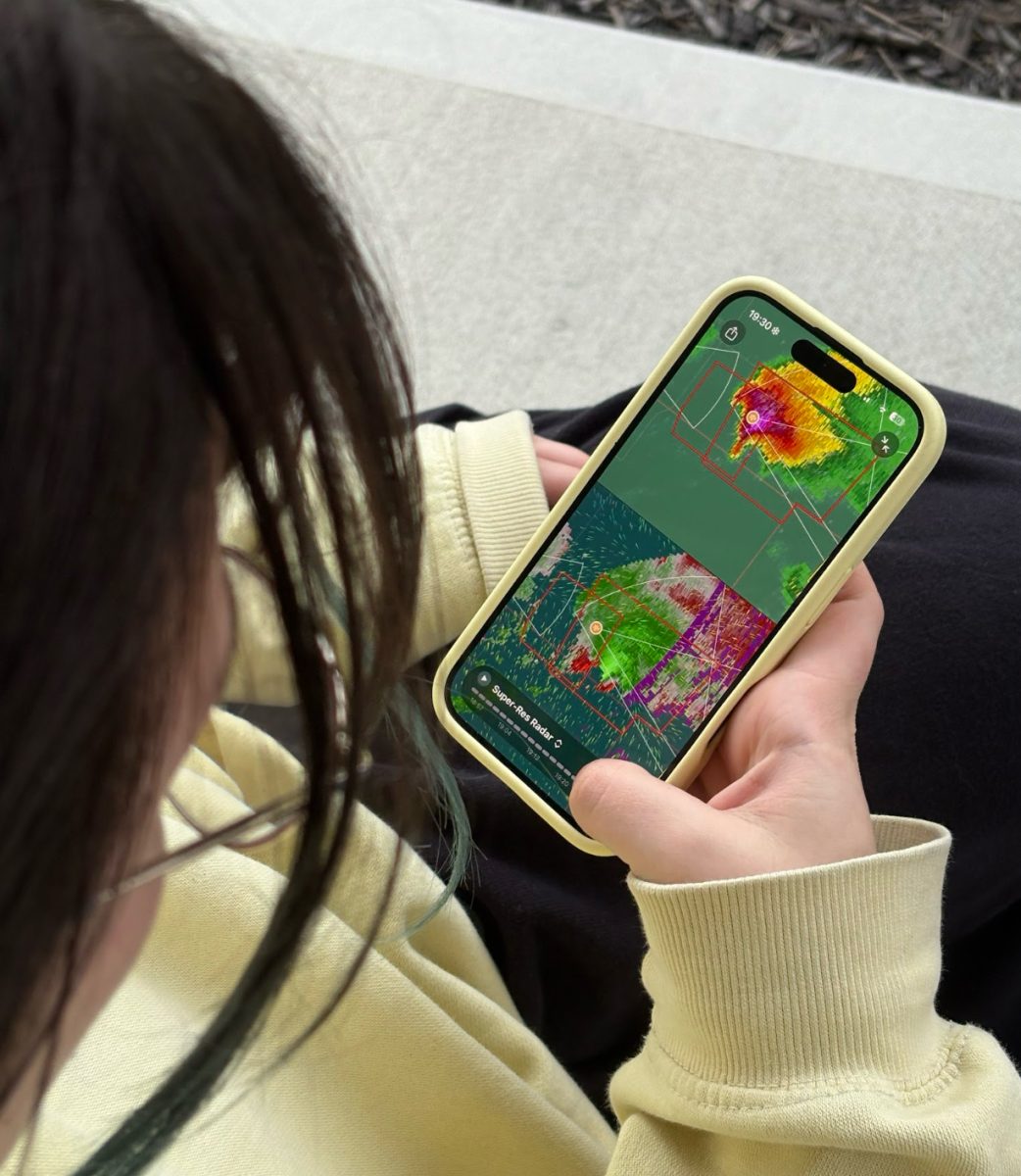
Hanners observes the weather through specialized apps on her phone.
“A basic view of any weather app should be storm reflectivity,” Hanner said. “This works and shows data by using radio waves to bounce off of things like water or snow in the atmosphere to measure precipitation. It then comes back as the colorful map on most basic weather apps with green being light rain and pink being heavy rain.”
She says these apps are simple enough for anyone to operate. Her favorite app is called CARROT, but she has several that she utilizes.
“Another map I like to use is a velocity map,” Hanners said. “This uses the Doppler effect to make data. It shows how fast wind is going inside of a storm and which direction. The main colors of this map are red, being wind going away from the radar, and green, being wind going towards the radar. The velocity map tracks rotation in storms, so if there’s a tight velocity couplet with bright red or green, that can indicate a possible tornado. There are other settings like correlation coefficient for debris, but knowing these two can help anyone when tracking storms on a radar.”
Hanners uses these apps to view storms from all around the United States.
“I usually observe them on the map because usually they’re not close, but sometimes if they are I go outside and watch them,” Hanners said. “I watch rain and snow because there’s a lot of that in Indiana. I’m always checking the weather map consistently. It’s so interesting to see and find these weather events.”
Hanners is often able to view local storms in person. She even got to see a tornado in June of 2023.
“I was obviously at a distance watching from my house,” Hanners said. “I was pretty fascinated. Since it was not on a path through our neighborhood we just did what a curious neighbor may do: walk outside to look.”
One of her most memorable moments of storm watching happened when she saw a tornado as a kid.
“I was younger when this tornado hit, but I had about the same knowledge I have today on it,” Hanners said. “I usually always monitor during any storms, but this one did feel more special. I remember standing out back and watching towards Indy from my back porch with my sister and dad. I had pointed out the rotation but my dad pointed out the touchdown of this tornado. We were pretty much watching it until the warning faded off, but as much as I remember it still is a key memory to me today.”
Hanners enjoys watching all types of storms, but she said her favorite has to be line storms.
“A line storm is a storm that comes in as thin lines with strong fronts,” Hanners said. “They usually produce very severe weather, and watching them is never boring. They usually have windy fronts and being able to experience them outside is always exciting for me.”
After years of being intrigued by storms and learning more about them, Hanners has decided to take her hobby to the next level and follow it as a career.
I knew I wanted to do meteorology for a living when I had realized how much I actually associated my school life with science,” Hanner said. “I had done many presentations from primary school to today associated with the weather. My plan was to go out to college and find somewhere where I can study meteorology. I heart Ball State has a nice weather program that I could try out. That’s what I’m hoping to be able to do.”
From the day Hanners first noticed storms to now planning her life after high school, she has come a long way.
“I used to be scared of storms, but now I step outside and feel the wind blow in my face as the sky turns dark and keep my eyes on radars any chance I get,” Hanners said.