
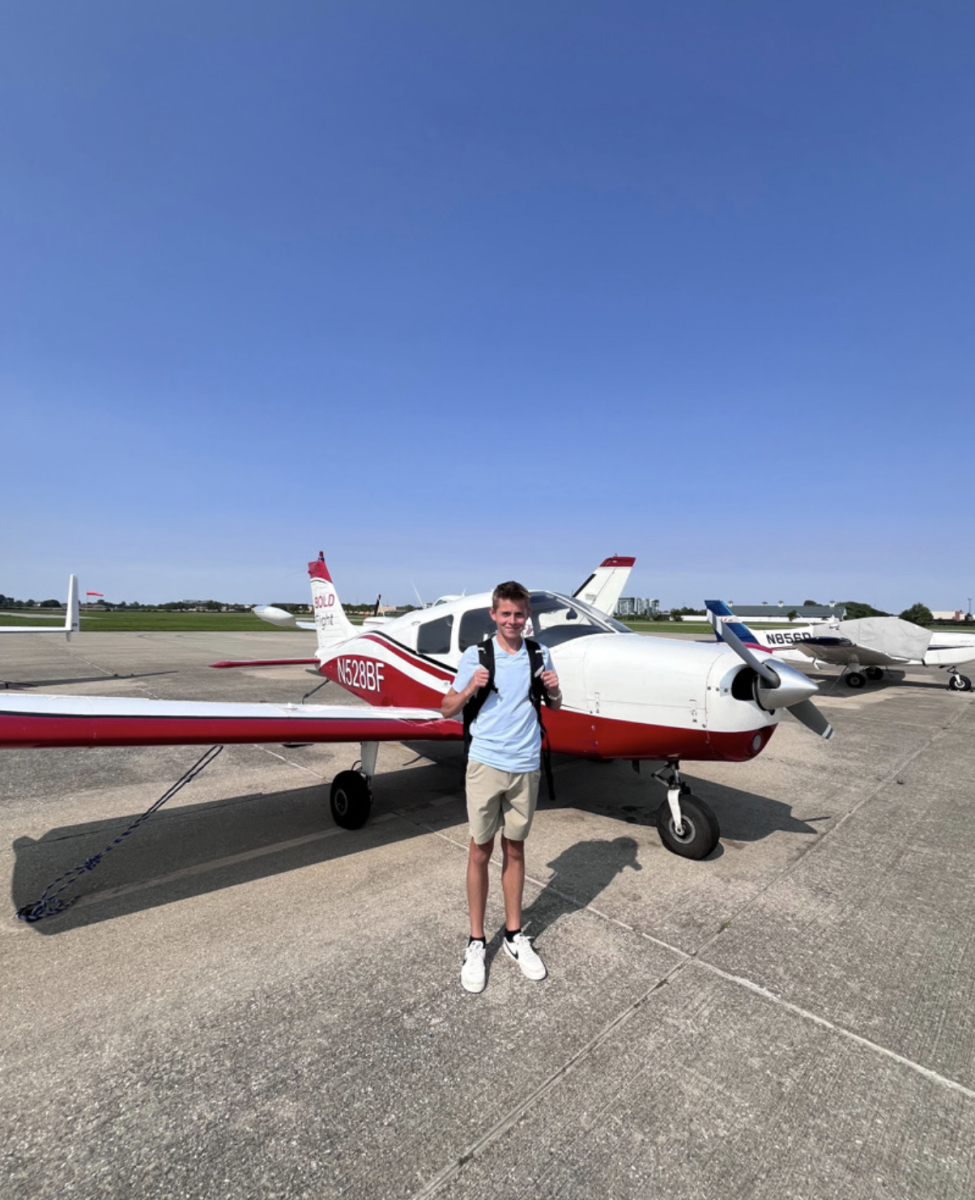
Juniors Benjamin Klassen and Ethan Holbrook crawl into the cockpit of the plane. They start both engines and taxi to the runway. They come to a stop and take one last deep breath before they push the thrust forward and speed up as they get sent off into their journey.
“I got interested in flying at a young age,” Holbrook said. “I began looking into different types of planes and all of the models of them. My favorite model was the Boeing 747. I was amazed at the size of it and wondered how something that big could fly in the air. Once I realized how much there was to flying, I knew I wanted to try it myself.”
Klassen has not yet begun his journey in the cockpit, but he is working toward completing the Aviation Management class at the Central Nine building.
“I took Aviation Management because I am interested in flying, and I want to prepare for a career in aviation,” Klassen said. “My goal is to go to college in the future to become a commercial pilot.”
The coursework for this class has required a lot of focus and dedication. An extensive process of memorization and research is required in order to pass this class.
“This semester we are studying for our private pilot written exam,” Klassen said. “The most challenging part about the class is studying for the private pilot test that is at the end of the semester. There are a total of 1500 different questions that we have to be prepared to answer.”
Along with taking the Aviation Management class at Central Nine, Holbrook has begun working toward his goal of becoming a pilot by working through in-person training.
“I’m currently working toward my Private Pilot License,” Holbrook said. “It’s really the first major step into being a pilot. I do my flight training at Bold Flight School airport with a flight school. I do one-on-one work with a flight instructor there.”
Flight training has many different shapes and forms. The early training process is a key step into turning a young student into a seasoned pilot.
“Training includes both studying on the ground and flying in the air,” Holbrook said. “I practice things like maneuvers, takeoffs and landings, and I sometimes go through different emergency situations and how to overcome them.”
There are many aspects of the training process that test a student’s patience and skill. For Holbrook, there have been many aspects of flying that he has struggled to overcome.
“The hardest part about my flight training has been staying consistent with landings,” Holbrook said. “It can get pretty overwhelming sometimes, and managing multiple tasks at once in the cockpit is also a very challenging part that has been difficult for me.”
Beyond the ordinary classroom, there are many skills required to be able to fly an airplane.
“In order to be a pilot, you need to be good at math and decision making,” Klassen said. “Whether it is preflight training or when you are in the air, these skills are some of the most important qualities that you need to have to be a pilot.”
Balancing school responsibilities with flight training requires discipline and a lot of sacrifice. Holbrook makes sure that academics are always his main priority while still finding time to pursue his passion of flying.
“I plan ahead and manage my time so school stays a priority,” Holbrook said. “Staying organized and up to date with my work helps me balance both. I want to continue earning more licenses and ratings, and in doing so I need to stay on top of all of my work.” Holbrook said. “Time management is very important to be a pilot, and I’m going to need it to pursue my goal of flying and eventually turn it into a career.”