
Walking into the Innovation Center, I’m met with the chaotic symphony of the grinding of years-old band saws, the screams of drills, and the loud reminders to wear safety glasses. As I look to my left, I see people hunched over ThinkPads, caught in the trance of the CAD software the team uses. To my right, I hear machines running, putting in overtime against the speakers blasting Bruno Mars’ new music. And in front of me, I see a shelving unit of unused and decade-old robots and their remains: the catacombs of this building.
This is Red Alert Robotics: the communion of engineering, programming, MATS (machining and training safety) and business operations. Since being founded in 2005 by teacher Summer Ehresman, Red Alert has competed under FIRST, an organization dedicated to spreading STEM. Every year, they create a robot for a uniquely-themed game. Themes have ranged from music to aquatics. This year’s is an archaeology-themed game called REBUILT. As the Engineering captain, junior Austin Petkovich leads this process of brainstorming and putting pen to paper of the best ideas: a Frankenstein of the team’s visions.
“It’s intense, everyone on the team splits into groups, envisioning a really successful robot,” Petkovich said. “We work a little bit off each one, and we nail out what we think is the best robot with the best strategy that we can go with.”
In this game, speed, agility and strategy are rewarded. Every game has two teams called alliances. Each alliance consists of three teams, each having one robot. Each match begins with a 15 second period where the robot is only powered by pre-programmed code. An alarm sounds, signaling a drive team of a driver and operator to reach for their controllers — fast. Foam balls have to be shot into an alliance’s pot, which can be active and inactive at certain times to keep matches competitive, and allows the tide of the game to change rapidly. They can also be given to human players around the field and carry out other functions, earning extra ranking points, which can sometimes edge out competition.
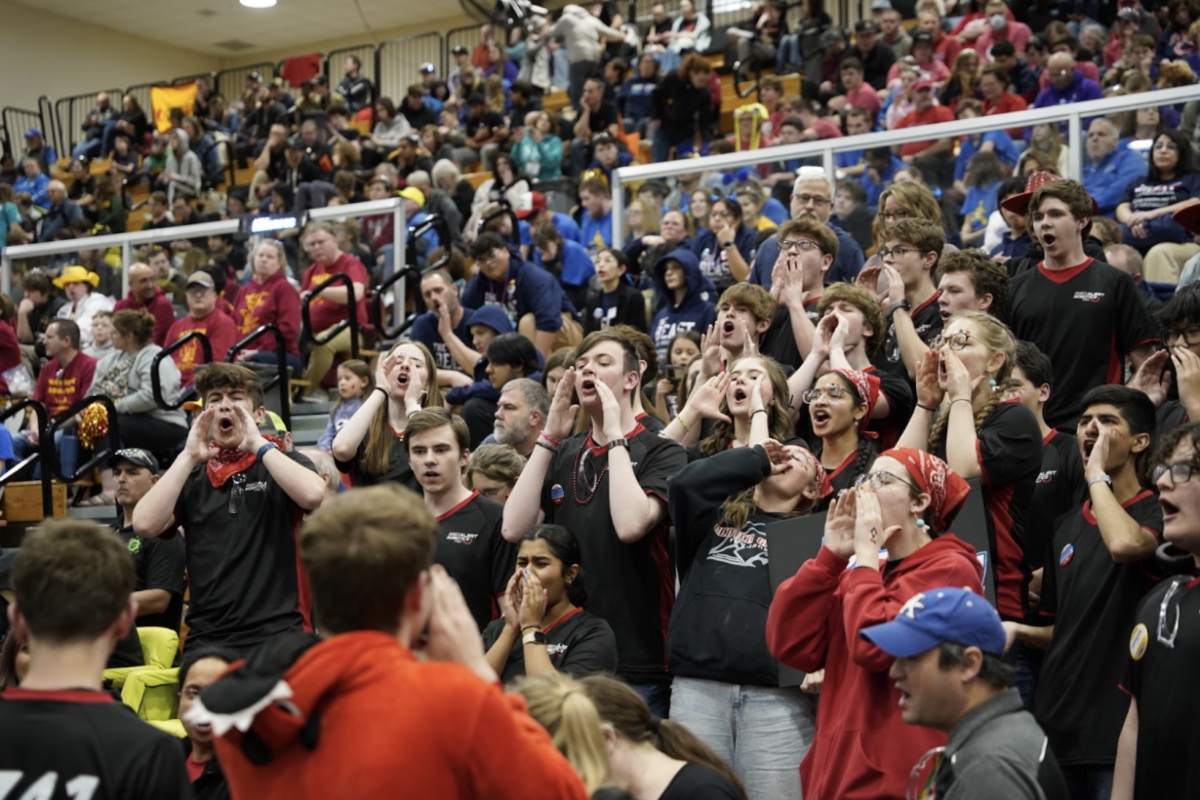
Sophomore Sarthak Ghoshal, an operator-in-charge of picking up game pieces and climbing, is one of the few people on the team with drive team experience through an offseason competition. He’s one of the few people surrounded by the noise of the crowd, feeling the stadium pulse at its peak.
“There’s a whole lot of yelling, but it drowns out as you get focused on the game,” Ghoshal said. “You just mute it out.”
The season for robotics is split into three sections: offseason, build season and competition season. The offseason is long, lasting from the end of the previous season in April to December. It’s an opportunity for the team to train new members, host outreach events and gain new sponsors. The business operations team mainly handles this in order to qualify for the FIRST Impact Award, the most prestigious award in the organization, given to teams that have best represented FIRST by spreading STEM to their community. This award is always acknowledged, providing teams with automatic qualification to the state and possibly the international level — often deemed the Olympics of STEM.
Red Alert has been a dominant team, winning the Impact Award 12 times on the district and state level and qualifying for the international FIRST Championship five times. Senior Ryan Merrill is one on the team who has experienced the benefits of this award.
“The Impact Award can get us a lot of sponsorships and start relationships,” Merril said. “It shows how a team has done more than just build robots.”
Kickoff is when the new game is revealed to teams worldwide. The team, after watching a reveal trailer explaining the game’s rules, will split into teams to decide what they envision as a successful robot. As the Engineering captain, junior Austin Petkovich helps lead meetings narrowing design concepts for the robot, painstakingly combing through pages of a roughly 160-page game manual to meet requirements down to the hundredth of an inch.
“The strategy of how we want to play the game is a huge factor in how we design the robot,” Petkovich said.
In competition season, the team goes to two district competitions, with this year being at Columbus and Lafayette, where they’ll compete against teams statewide, from Carmel’s TechHounds to Pike’s Robodevils. The top 38 teams in Indiana qualify for the Indiana State Championship, where teams have the opportunity to qualify for the FIRST Championship. Last year, Red Alert was one of those teams, where 600 of the world’s best teams, from countries like the Dominican Republic, Brazil, France, Türkiye, Israel, and Australia gathered in Houston to compete for a championship banner.
“Every competition pushes us to think faster and work smarter,” Petkovich said. “Making it to the State Championship last year showed us we belong here, and competing in Houston proved that our hard work can stand with the best teams.”
The team aims to produce an agile robot that prioritizes a high intake and shooting of game pieces from anywhere, being a fierce competitor amongst other top teams in Indiana.